
ZIP 33019
Hollywood Beach
Broadwalk, beachfront condos
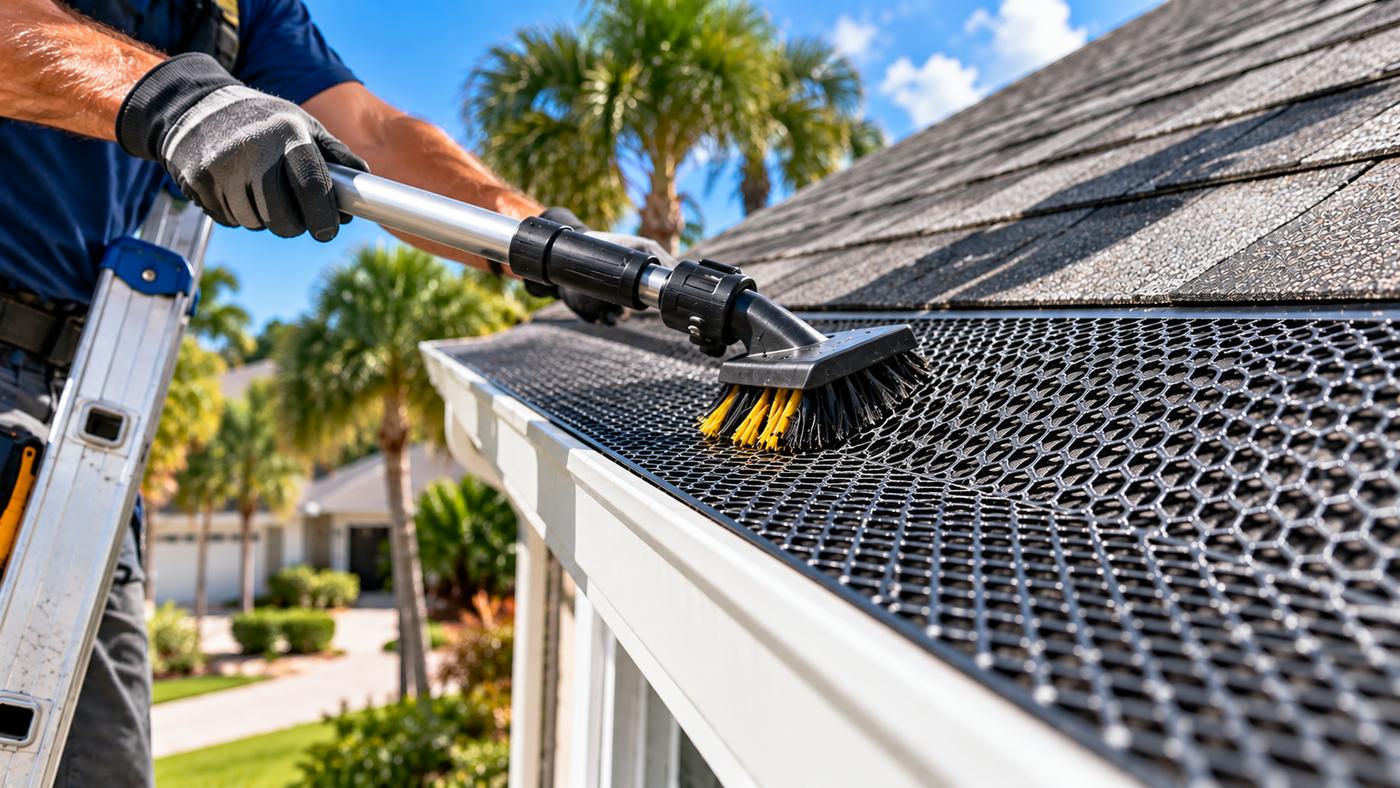
See ZIP 33019Gutter guard cleaning means cleaning the guard or screen on top of your gutter and clearing the trough underneath it. Guards stop leaves. Pollen, seed pods, and roof grit pile on top or slip through, so most guards still clog. Fast Pro cleans the guard, clears the trough, and flushes the downspouts.
Serving Hollywood, FL homeowners. 6+ years of experience. 550+ jobs completed. Last updated .
Every guard cleaning includes
Free inspectionGuards on Hollywood homes still collect palm fiber, leaf litter, and salt residue near the water. We clean the guard surface and clear the trough beneath it, with extra care on beachfront and canal-front hardware.
Gutter guards across Hollywood face different conditions depending on the neighborhood. Near the Broadwalk and the beach, salt air and humidity can corrode thin guard material faster than it would a few blocks inland, and we check the guard's condition along with cleaning it. In the historic downtown core, the older tree canopy means more leaf and seed-pod volume for the guard to handle in the first place.
Whatever lifts without stressing the frame gets brushed and rinsed, and the trough below it gets cleared out by hand. On an older property, the guard's mounting gets checked first, since a retrofit on decades-old fascia isn't always as secure as one installed alongside newer gutters.
Beachfront condos and newer construction generally see less guard wear from debris than the historic or canal-front sections of the city, though salt exposure there can still be significant.
On the busiest sections of the Broadwalk, guards sometimes show salt buildup fast enough that an annual cleaning isn't quite enough, and we flag that during the visit rather than waiting for it to become a bigger problem.
Yes. Guards change what lands in the trough and how often you have to deal with it. They do not end the job.
A guard works like a lid. It keeps big debris out, and water has to pass through or around it. Whatever the lid cannot pass stays on top, and whatever it lets through settles underneath. Pollen, seed pods, and roof grit are the usual culprits.
| Guard type | Blocks well | What gets through or piles up | How we clean it |
|---|---|---|---|
| Micro-mesh | Needles, seed pods, most roof grit | Wet pollen can film the surface and slow the water | Brushed and rinsed on top, trough flushed through the mesh or from the end |
| Screen or perforated | Large leaves | Needles, pollen, and grit pass through and settle underneath | Lifted where possible, cleaned, trough cleared by hand |
| Reverse-curve (surface tension) | Leaves and large debris | Fine debris can collect at the nose opening | Opening cleared and rinsed, trough checked and flushed |
| Foam inserts | Large debris, at first | Seeds sprout in the foam and debris embeds in the pores | Pulled and rinsed, or replaced if clogged through |
| Brush inserts | Large debris | Debris tangles in the bristles and holds water | Pulled out and shaken clean, trough cleared by hand |
We clean the guards that are already on your house. If you are weighing guards for a house that has none, tell us what falls on your roof first. The right guard depends on it. The gutter cleaning page lists what we pull out of an unguarded trough.
The steps change with the guard, so we start by finding out how yours is attached.
We look at the type, the material, and how it attaches. Some guards slide out, some hinge up, some are screwed down, and some tuck under the first row of roofing.
Sections that come up cleanly get lifted and set aside. We do not force a guard that is screwed or tucked, because bent frames leave gaps where debris gets in.
Surface debris comes off with a soft brush, and the guard is rinsed on both sides so the openings are clear.
This is where the pollen paste, seed pods, and roof grit have collected. We scoop it out and bag it, the same as on an unguarded gutter.
Water runs through each run and each downspout until the flow is steady. A guard does not stop a blockage at the elbow.
Each guard goes back flat against the roof edge and the gutter lip. A gap or a lifted corner lets debris in on the next storm.
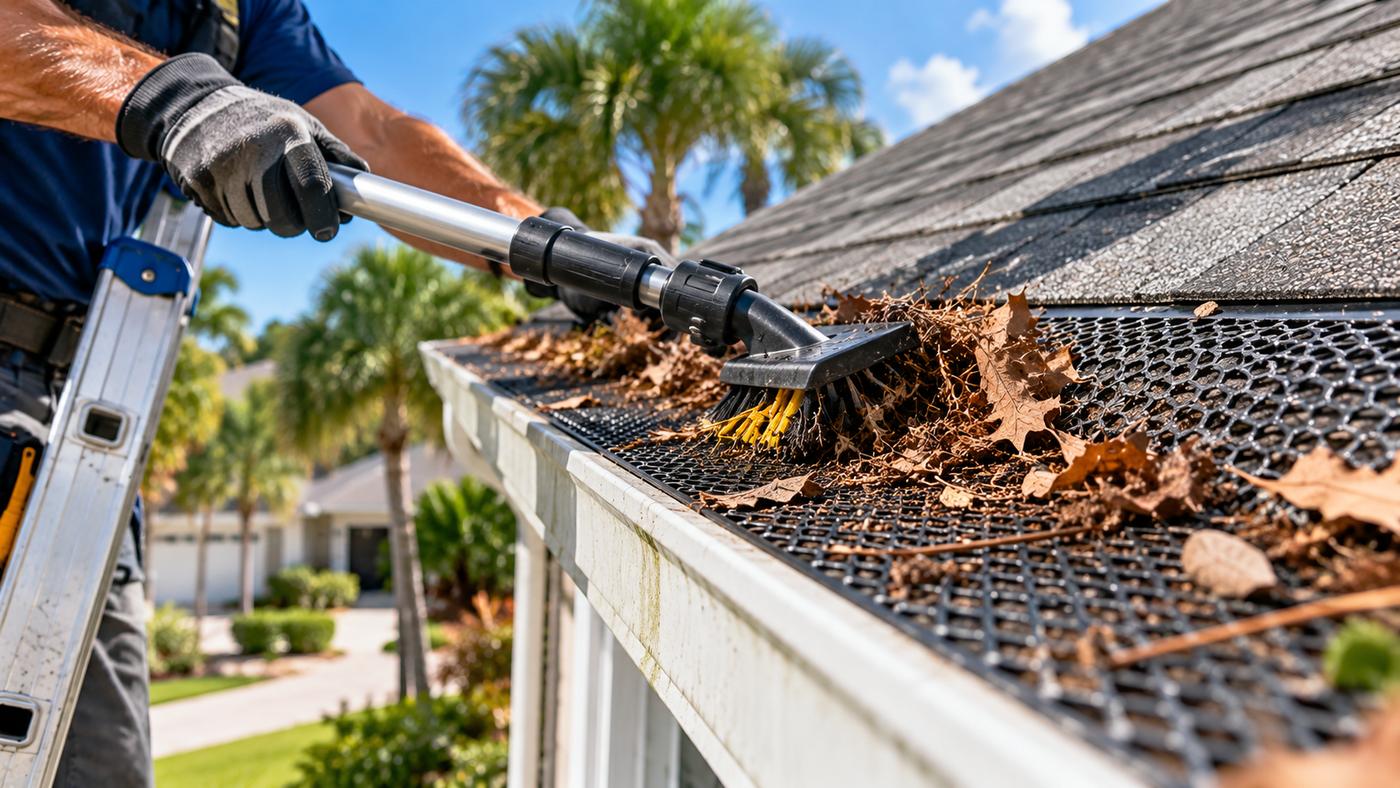
You see the guard and the trough before and after, plus a plain note on any bent, cracked, or missing sections.
Pollen and fine debris sit on top of the guard, so we clean the surface before we reach the trough.
The same section of gutter, photographed from the same spot before and after.
Pick your ZIP code to see the neighborhoods we cover, or call and we will confirm your street.
Hollywood Beach
Broadwalk, beachfront condos
See ZIP 33019Downtown Hollywood
Historic downtown core
See ZIP 33020West Hollywood
Western Hollywood
See ZIP 33021South Hollywood
South Hollywood
See ZIP 33023Southwest Hollywood
Southwest Hollywood, near Pembroke Pines border
See ZIP 33024Not sure we cover your ZIP code? Call us at (813) 856-2726.
It depends on the feet of gutter, the number of stories, and whether the home is beachfront, canal-front, or farther inland. Call with your address and we'll have a price ready for you.
It depends on the roof size, material, and salt exposure. A beachfront condo and an inland bungalow are different jobs. Share your address and we'll price it by phone.
The visit that counts most is early May, just ahead of the wet season. Plan another between October and December once hurricane season has wound down.
Yes. Salt air along the beach speeds up oxidation and algae growth compared to a drier, more inland property.
We cover the city end to end, from the Broadwalk and beachfront to the historic downtown core and the canal-front neighborhoods inland.
The 2017 storm caused real damage across the city. If your roof hasn't been checked since, a cleaning is a good time to spot anything that needs a closer look from a roofer.
Generally, yes. West Lake Park's inland properties deal more with mature tree canopy, while Broadwalk homes deal more with direct salt exposure.
Yes, along with the rest of Hollywood. Share your street and the closest cross street when you call us.
Often, yes. Salt air near the water speeds up corrosion on thin guard material compared to an inland property.
At least once a year, more often under heavy canopy downtown or with heavy salt exposure near the Broadwalk.
Generally less salt corrosion, yes, though the heavier tree canopy there means more leaf and seed-pod buildup instead.
Call and tell us what guard you have and what you see on top. We quote by phone and find a day that works.
Call (813) 856-2726